
Design Pattern & Best Practice Review Agent
AI-Powered Apex Code Quality Analysis for Salesforce
Continuous, Automated Code Quality Reviews — Without a Single Manual Request.
As a Salesforce codebase grows, keeping every Apex class and trigger aligned with best practices becomes increasingly difficult. Developers write code against deadlines. Reviews happen inconsistently. Issues like governor limit risks, missing security checks, and poor error handling go unnoticed — until they cause a production incident.
The Design Pattern and Best Practice Review Agent changes the model. Every time an Apex class or trigger is created or modified, the agent automatically reviews it against Salesforce-specific quality criteria in the next run and stores a structured findings report — complete with identified issues, recommended fixes, and an overall severity rating.
See It In Action
Watch how the Design Pattern and Best Practice Review Agent automatically analyses modified Apex code against seven quality dimensions and produces a structured findings report — without any manual code review.
Design Pattern & Best Practice Review Agent — Demo
Why Apex Code Quality Issues Go Undetected
Manual code review is the most common quality gate in Salesforce development — but it does not scale, and it is never fully consistent. As teams and codebases grow, the gap between what gets reviewed and what gets deployed widens:
How the Review Agent Works
The agent runs automatically on a recurring schedule, scanning only the Apex classes and triggers that have been created or modified since the last completed review cycle. Each changed artifact is submitted to an AI model with a structured set of Salesforce-specific quality criteria, and the findings are stored as a reviewable record in Salesforce.
The process runs in four steps, entirely without manual initiation:
Step 1 — Changed Artifacts Identified
At the start of each run, the agent identifies every Apex class and trigger modified since the last successful review cycle. Only changed code is reviewed — unchanged artifacts are skipped, keeping the process efficient regardless of overall codebase size.
Step 2 — AI Reviews Each Artifact
Each artifact is submitted to an AI model with a detailed set of Salesforce-specific review criteria. The AI reads the full source code — including large classes, which are processed in sections to ensure nothing is skipped — and evaluates it across seven quality dimensions.
Step 3 — Findings Structured and Stored
The AI returns a structured quality report for each artifact: a list of issues found, a concrete fix recommendation for each issue, a total issue count, and an overall severity rating. Each report is saved as a Salesforce record linked to the source artifact.
Step 4 — Watermark Advanced for Next Run
Once a run completes without errors, the review cycle timestamp is updated automatically. The next scheduled run picks up only artifacts modified after this point — ensuring every change is reviewed exactly once, and any artifact affected by an error is automatically retried on the next cycle.
Functional Flow Diagram
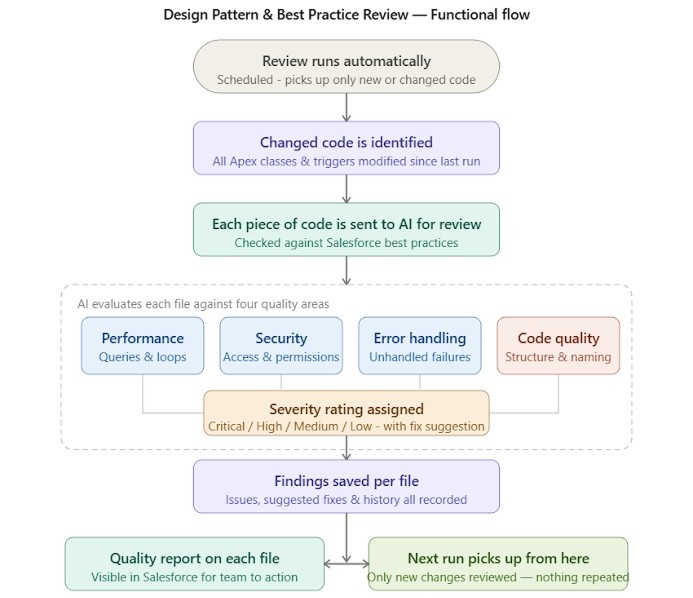
Technical Solution Overview
The Design Pattern and Best Practice Review Agent is an Agentic solution built natively on the Salesforce platform. The orchestration layer runs autonomously end-to-end — continuously scanning for changed Apex artifacts, submitting each to an AI model for structured quality analysis, storing findings as Salesforce records, and advancing the review watermark — without any manual initiation or intervention. Each capability is delivered through Salesforce technologies as follows:
Architecture Principle: Deterministic Apex handles all scheduling, artifact detection, watermark management, and record persistence — guaranteeing auditability and reliability for code that runs in production. Generative AI prompt templates handle quality evaluation and natural-language fix recommendations. The combination makes the system truly agentic: it runs end-to-end on its own, reviews every change exactly once, and surfaces actionable findings without waiting to be asked.
Key Features
Incremental Scanning — Only Changed Code Is Reviewed
The agent does not re-review the entire codebase on every run. It tracks a review cycle timestamp and only picks up artifacts modified since the last completed run. This keeps each execution fast and focused, regardless of how large the overall codebase grows.
Seven-Dimension Quality Review — Covering the Issues That Matter Most
Every artifact is evaluated against a comprehensive set of Salesforce-specific quality criteria that covers the categories most likely to cause production incidents, security vulnerabilities, or long-term maintainability problems.
Structured Quality Reports — Issues, Fixes, and Severity in One Record
Each review produces a structured quality report stored as a Salesforce record linked to the source artifact. Reports are consistent in format across every class and trigger reviewed, making findings comparable, reportable, and actionable without any manual formatting or interpretation.
Full Coverage for Any Class Size — No Artifacts Skipped
Large Apex classes are reviewed in full, not truncated. The agent automatically splits oversized source files into sections and processes them sequentially, maintaining full context across sections so the AI can assess the complete artifact rather than an incomplete fragment.
Business Impact
For Developers
For Technical Leads & Architects
For Operations & Business Leaders