
Governor Limit Risk Prediction Agent
AI-Driven Governor Limit Risk Analysis for Salesforce Apex
Know your governor limit risks before they hit production — before it is too late to act.
See It In Action
Watch how the Governor Limit Risk Prediction Agent scans the Apex codebase, builds a dependency graph, and identifies transaction chains at risk of hitting governor limits — before they reach production.
Governor Limit Risk Prediction Agent — Demo
Why Governor Limit Risks Go Undetected
As a Salesforce codebase grows, keeping every Apex class and trigger free of governor limit risks becomes increasingly difficult. Developers write code against deadlines. Reviews are inconsistent. And the structural risks — SOQL in loops, unbounded DML, cross-method callout chains — are invisible in a single-file review. They only surface when they cause a production exception under real data volumes:
How the Governor Limit Risk Prediction Agent Works
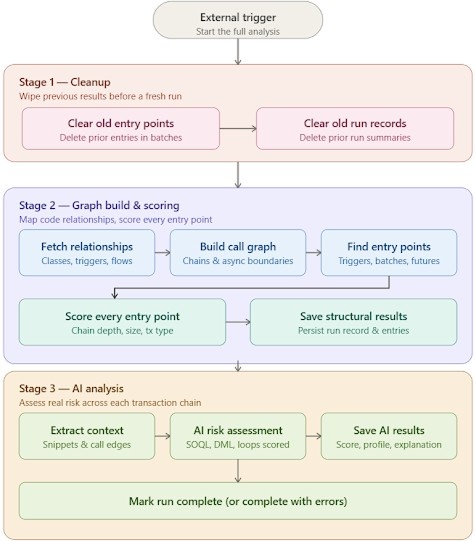
Rather than relying on manual review, the agent automatically scans the entire Salesforce Apex codebase, builds a full dependency graph, and uses AI to independently assess every transaction chain for SOQL, DML, and callout exposure. The process runs in three stages, entirely without manual initiation:
Stage 1 — Cleanup — previous results cleared
Old analysis run records and entry point records are deleted in bulk chunks before each new run, ensuring every analysis starts with zero data pressure and results always reflect the current state of the codebase.
Stage 2 — Graph build and structural scoring
The Salesforce Tooling API is used to fetch all Apex class, trigger, and Flow dependencies. A full adjacency map is built, async boundaries (Batch, Queueable, Schedulable, @future) are detected, and every transaction entry point is scored structurally — chain depth, chain size, transaction type, and parent callers.
Stage 3 — AI analysis — GPT-4o scores every entry point
For each entry point, risky method snippets and call graph edges are extracted from symbol tables and submitted to OpenAI GPT-4o. The AI counts SOQL, DML, and callout operations; identifies looped and recursive patterns; assigns a risk score of 0–100; and writes a plain-English explanation naming the specific classes and methods at risk. Results are written back to Salesforce automatically.
Example output — entry point risk assessment
| Entry Point | Transaction Type | Chain Depth | Risk Level | Score |
|---|---|---|---|---|
| AccountTrigger | Trigger | 5 | HIGH | 78 / 100 |
| OpportunityService.syncAll | Queueable | 4 | MEDIUM | 52 / 100 |
| LeadBatchProcessor | Batch | 2 | LOW | 21 / 100 |
Governor Limits Tracked
Every transaction chain is scored against the hard Salesforce per-transaction resource caps. Async chains are assessed against the correct limit set for their transaction type.
| Limit | Cap |
|---|---|
| SOQL Queries | 100 (Sync) / 200 (Async) |
| DML Statements | 150 per transaction |
| HTTP Callouts | 100 per transaction |
Functional Flow Diagram
Technical Solution Overview
The Governor Limit Risk Prediction Agent is an Agentic AI solution built natively on Salesforce, combining the Salesforce Tooling API, Apex automation, and OpenAI GPT-4o to autonomously scan an entire Apex codebase, build a full dependency graph, and assess every transaction chain for governor limit exposure — without any manual initiation.
Each capability is delivered through the following components:
Architecture principle: Deterministic Apex guarantees accuracy and auditability for dependency graph construction, structural scoring, and limit threshold calculation; GPT-4o handles language, pattern recognition, and risk explanation; and the automated batch pipeline makes the system truly agentic — running the full org scan end-to-end on a single trigger, without manual intervention at any stage.
Key Features
Full Org Scan — Every Entry Point Assessed in a Single Run
The agent scans the entire Apex codebase in one execution. Every trigger, sync class, batch, queueable, scheduled class, and @future method is treated as a separate transaction entry point and scored independently.
Async Boundary Awareness — Correct Limits Applied Per Transaction Type
The agent distinguishes six transaction types and applies the correct governor limit set to each. Async chains are not scored against sync limits — every entry point is assessed fairly against what Salesforce actually enforces.
Cross-Method Loop Detection — Risks That Single-File Review Misses
The most dangerous governor limit patterns span multiple classes. The agent traces the full call graph to identify SOQL, DML, and callout operations that execute inside loops — even when the loop and the operation are in different classes.
AI Risk Scoring — Scores Grounded in Actual Code Signals
GPT-4o analyses each entry point and returns a structured risk assessment calibrated to the actual patterns found in the code — not a generic heuristic score.
Business Impact
The Governor Limit Risk Prediction Agent delivers value across every level of the Salesforce development organisation — from individual developers to technical leadership and business operations.
| For Developers | For Technical Leads & Architects | For Operations & Business Leaders |
|---|---|---|
| Receive a structured risk score on every transaction chain — not just the code paths that get manually reviewed | Full org-wide risk visibility in a single run — not one file at a time | Reduce the risk of governor limit failures reaching production and causing service disruptions |
| Plain-English AI explanations name the specific classes and methods that need attention | Async boundary awareness ensures Batch, Queueable, and Future chains are scored against the correct limits | One triggered run scans the entire org — no ongoing reviewer headcount or tooling cost |
| Breach percentages show exactly how close each chain is to its limit — prioritise with confidence | Risk scores, breach percentages, and transaction patterns stored as native Salesforce fields — reportable immediately | Results live in Salesforce: dashboards, list views, and alerts available from day one |
| Issues surfaced before deployment, not after a production governor limit exception | Historical run records show how org risk evolves over time as the codebase changes | No additional Salesforce licensing, no external tool, no lengthy implementation required |